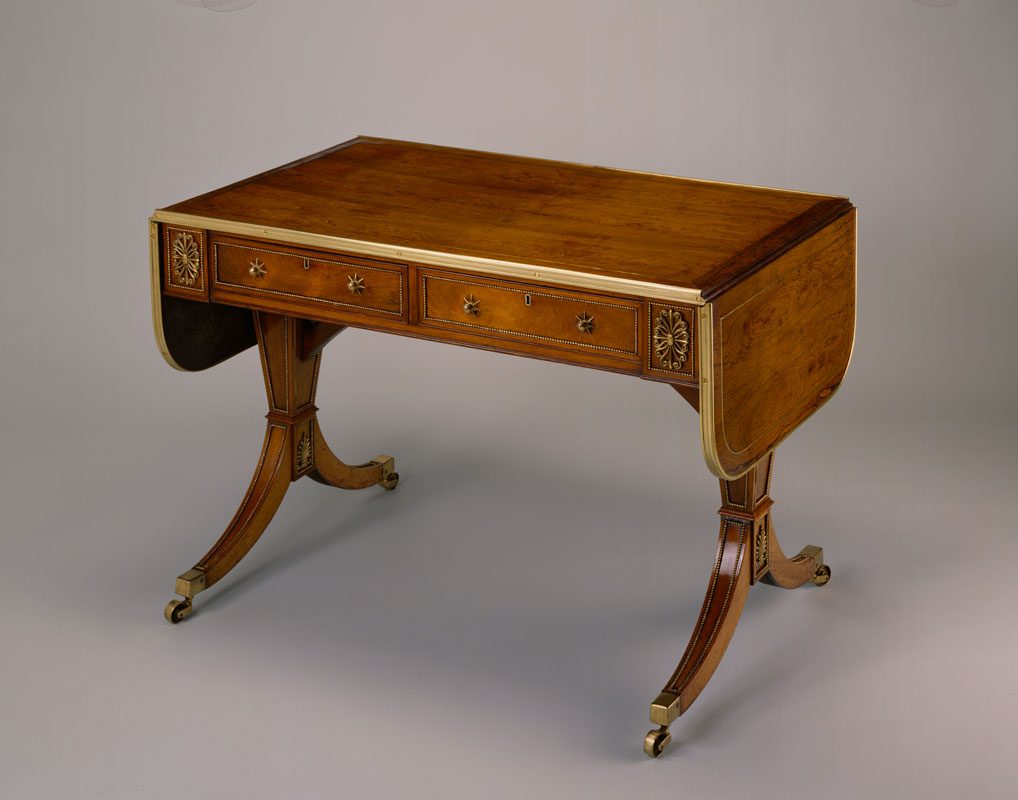
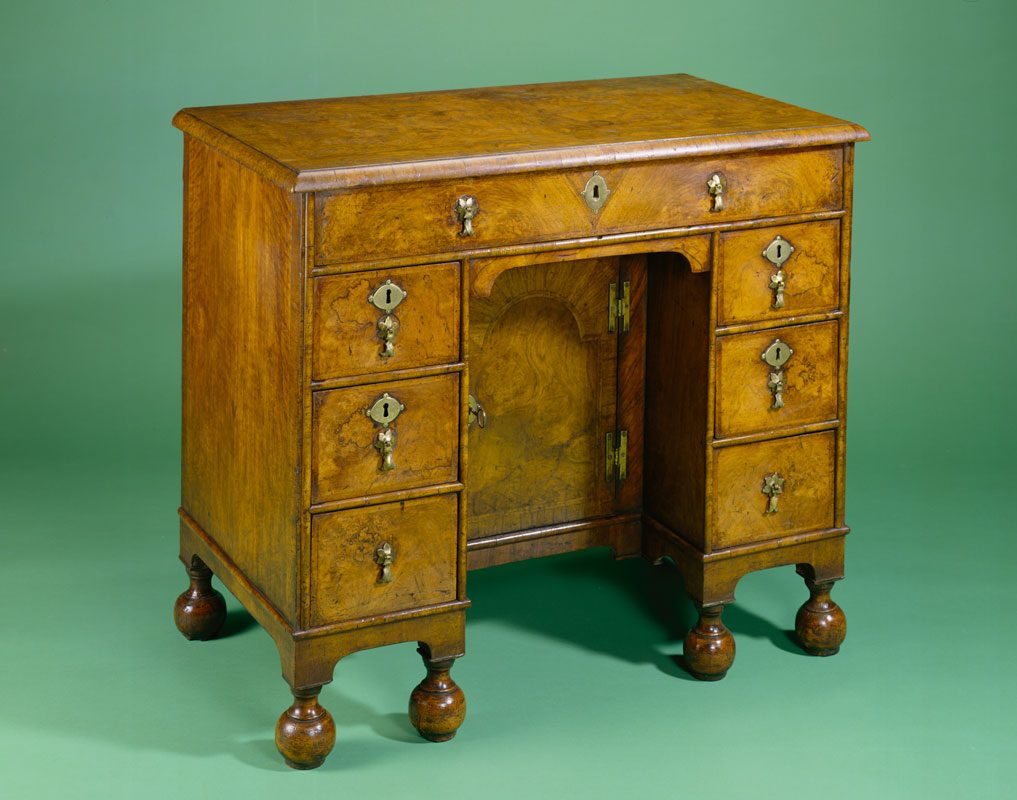
A fine faded rosewood sofa table with brass mounts and inlaid lines, shown on completion of treatments, from around 1805.
This fine table was displayed at the B.A.D.A Art Treasures Exhibition in Bath in 1958, and later that year the present owners purchased it.
The satisfying overall simplicity of line of the old base, carefully counter-balanced by the lavish use of boldly shaped anthemion mounts, brass-beading and cast brass mouldings to the leaf edges, are all indicative of a quality all too rarely encountered today (the handles are later replacements).
Before repairs, there was an unsightly jagged break running the length of the centre board where the oak base timber, to which the rosewood veneer is fitted, had shrunk relative to the end cleats which run front to back across the main leaf, causing damage.
Shrinkage problems are often encountered on sofa tables which are vulnerable to damage of this type in today’s drier, warmer home environments. The shrinkage of the top had also caused the inlaid brass to spring up above the surfaces of the leaves to which they were fitted.
We carefully removed the end cleats of the centre leaf section, their position approximately corresponding to the mitred end veneers fitted next to the rule joints; we were then able to carefully work a very discreet jointline where the fracture breakage had occurred, removing only a minimum of timber, and in reassembling we were careful to ensure a flush fit of the old polished surfaces at the glueline. To make up the loss in width of this centre section, an additional strip of antique oak was fitted on the underside of the leaf near the back brass line, and the missing narrow strip of rosewood was replaced with faded antique old surface rosewood with suitable grain and figuring.
The inlaid brass lines were straightened where distorted, and refitted, trimming the mitres slightly where necessary. The cast brasswork was returned to clean polished condition although the bright gloss appearance was gently toned down, as was felt to be appropriate. (This cleaning work was contracted out to a specialist metalworker.)
The colour of the top was modestly modified; not primarily by staining, but instead by careful removal of a perished layer of faded polish which had turned grey-white in strong sunlight; on removal of this clouded polish, the glorious warm honey-coloured tone of the faded rosewood veneers was revealed below.
Great care has to be taken when working with faded rosewoods as the desirable faded tone of the timber surface is only paper-thin; this colour is rapidly replaced by the intense purplish-black colour of unfaded timber if even modest abrasion or scraping is carried out; bleaching of these purple-black rosewoods to return a lost faded colour is rarely completely successful. As can be seen from the photograph, the colour of the completed top is now more consistent with the drawer-fronts and frieze below.